
- Home
- Company
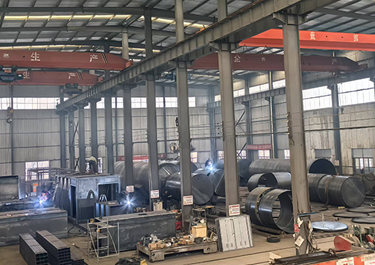 Our FactoryWe have a team of over 30 talented mobile fuel station R&D experts, as well as a 50,000-square-meter advanced modern intelligent manufacturing plant.
 - Mobile Fuel Station
- Storage Tank
- Blog
- Contacts
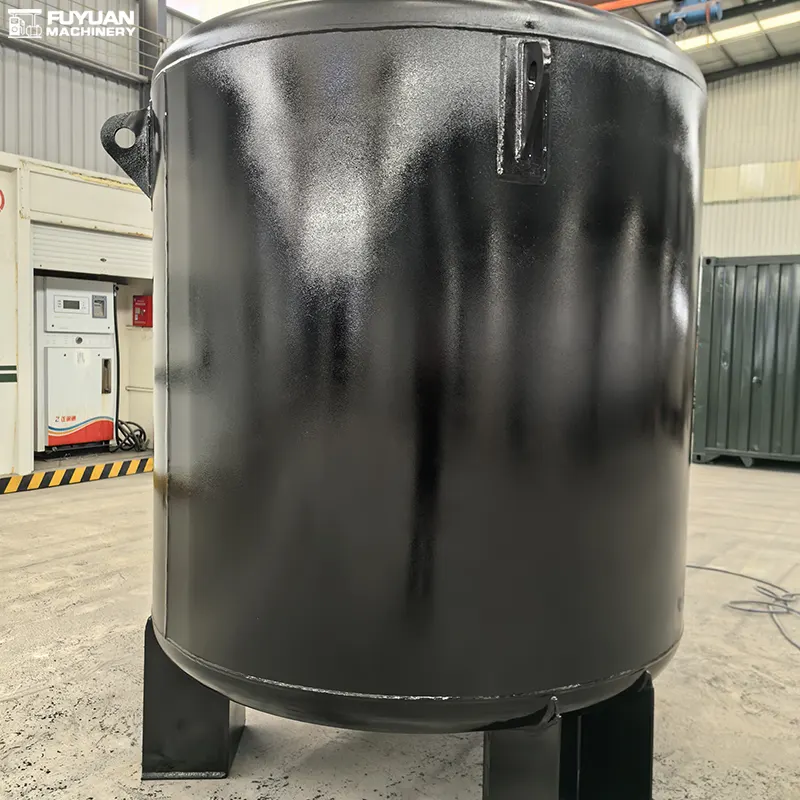
Best Mobile Fuel Stations Buying Guide: 6 Cost Factors to Consider
Two quotes for a 30,000L mobile fuel station land on your desk. One is $28,000. The other is $65,000. Same capacity. Same fuel type. Same delivery timeline. The difference is not a pricing error—it is the gap between a stripped-down unit and one built for 15 years of continuous operation in a remote mining camp.
Mobile fuel station pricing is notoriously opaque. Two units that look identical on a spec sheet can differ by 200% in cost because of decisions made deep inside the tank, the dispenser, and the certification package. This buying guide breaks down the 6 cost factors that determine what you actually pay—and what you actually get.
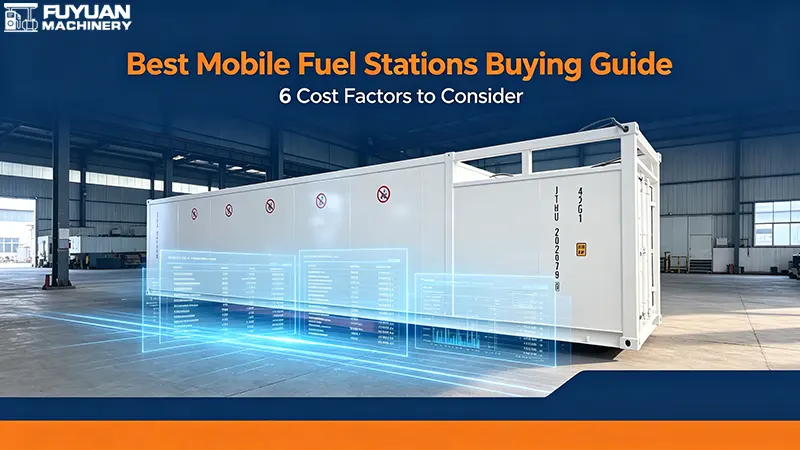
Factor 1: Station Type and Structural Format
The first and most significant cost variable is the format you choose. The three mainstream mobile fuel station types—skid-mounted, containerized, and trailer-mounted—each carry different baseline costs.
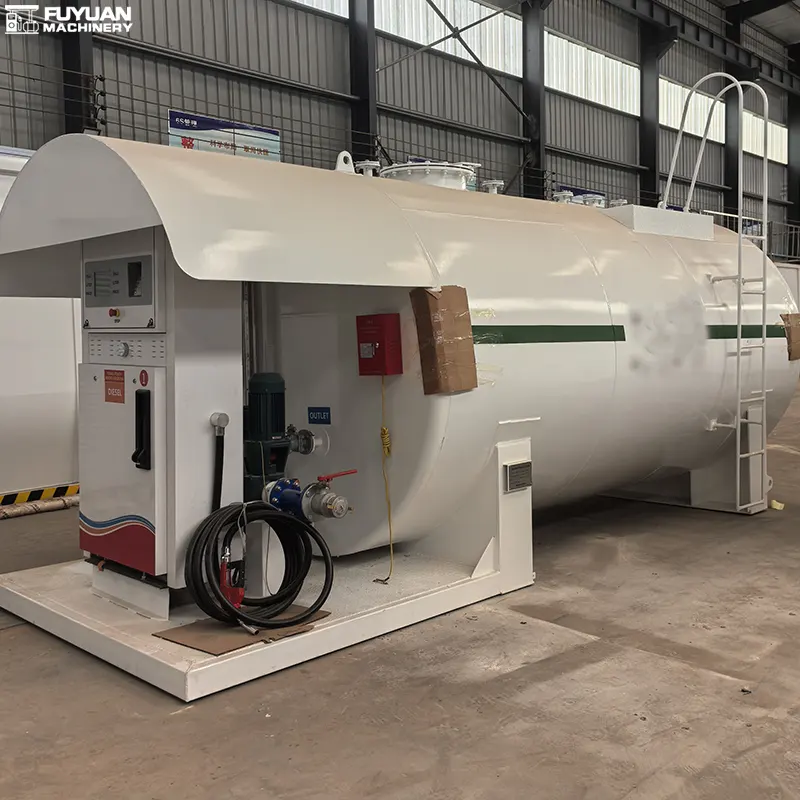
Skid-mounted fuel stations feature an open structure where all equipment is integrated onto a steel base without an enclosed shell. Their primary advantage is the lowest cost—being 10% to 30% cheaper than containerized versions for the same capacity—and highly flexible capacity customization ranging from 1,000 to over 60,000 liters without being constrained by container dimensions.
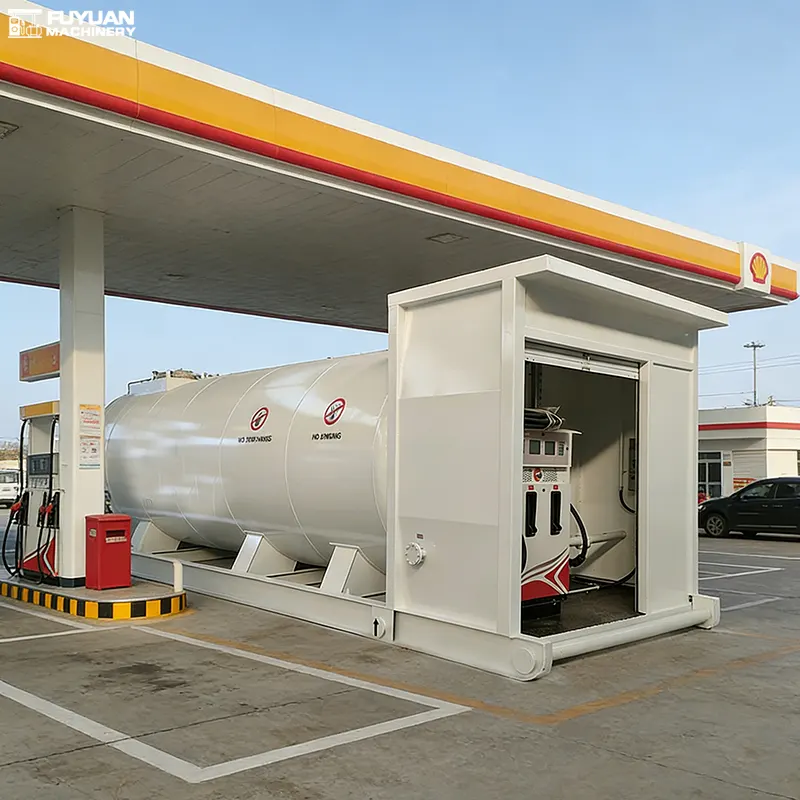
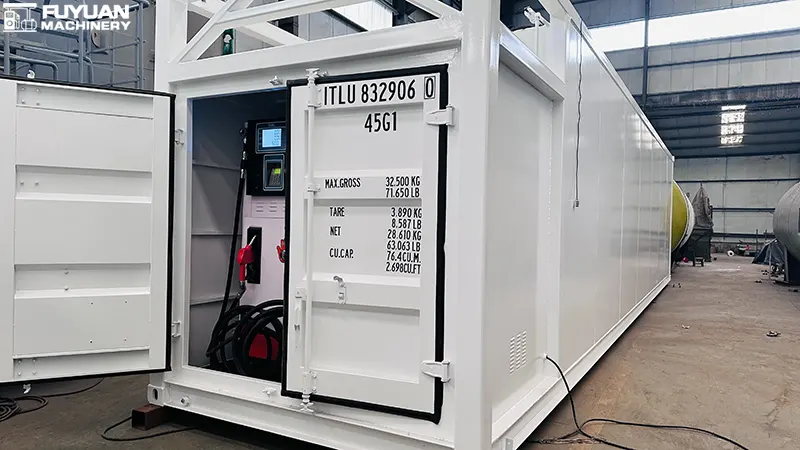
Containerized fuel stations house equipment inside a standard ISO container, which serves as the outer shell. The container effectively withstands wind, sand, rain, snow, and salt spray, significantly extending equipment lifespan. Holding CSC certification allows for shipment as standard containers, facilitating global transport. However, this protection comes at a premium. Container fuel stations typically cost 10–30% more than an equivalent open skid for the same capacity.
Trailer-mounted fuel stations are integrated onto a trailer chassis and can be towed by a vehicle, offering the highest mobility. They are ideal for frequent relocation but require road-legal certification and compatible towing vehicles, adding to the overall cost.
Typical ex-factory price ranges by format (10,000L capacity equivalent):
| Format | Price Range (USD) | Best For |
| Open skid | $25,000 – $55,000 | Budget-conscious, mild climates, large capacity |
| Containerized | $35,000 – $80,000 | Harsh environments, security, international shipping |
| Trailer-mounted | $40,000 – $90,000 | Frequent relocation, emergency response |
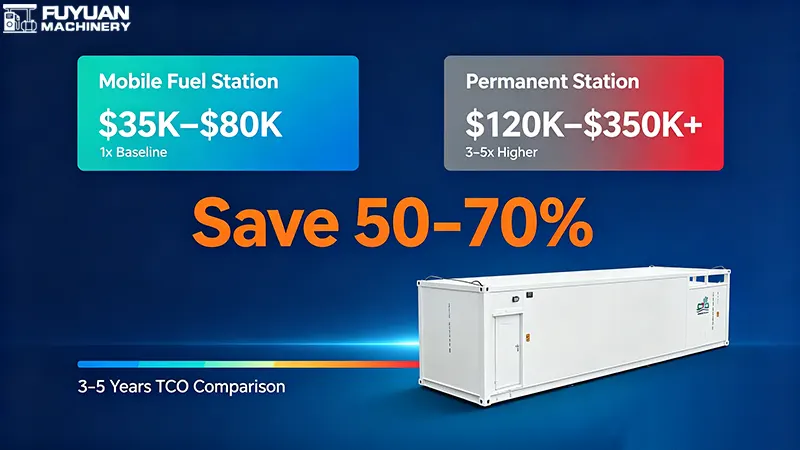
A 7m³ skid-mounted unit with barrier explosion-proof design lists at approximately $22,607. A 40FT container fuel station with integrated dispenser and smart management system ranges from $13,000 to $20,000 depending on configuration and optional features. For a more realistic comparison, a 10,000L system costs $35,000 to $80,000 for a mobile station versus $120,000 to $350,000+ for a permanent station.
Factor 2: Core Equipment Configuration and Component Quality
This is where the largest price differences hide—and where buyers most often get burned.
The core components of a mobile fuel station are the fuel tank, explosion-proof materials, and fuel dispensers. The brand, material, and technical grade of these components directly determine the cost.
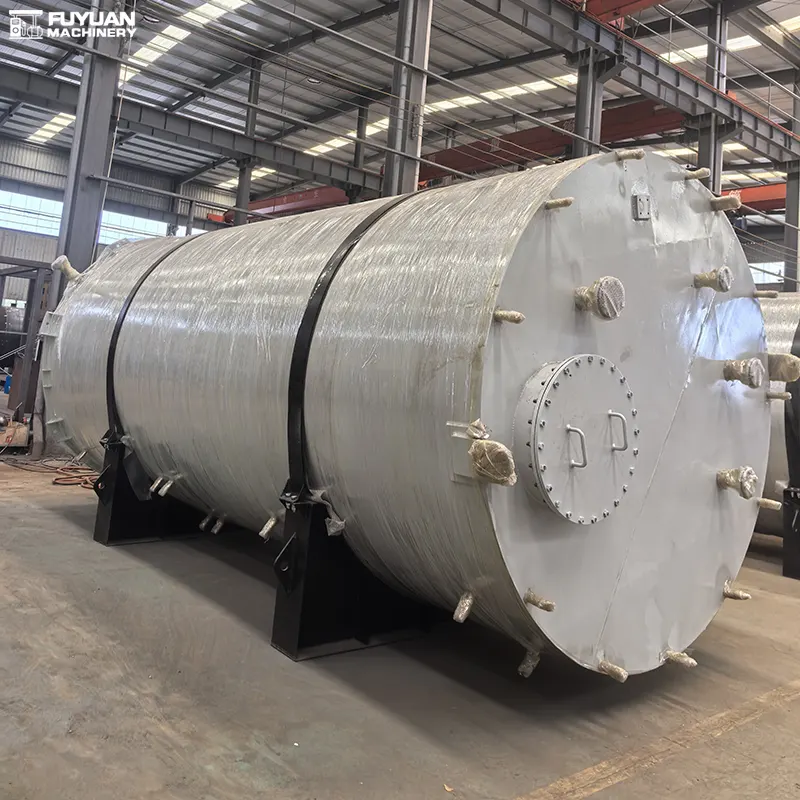
Fuel tank: Material choice alone can swing the price by 30–50%. Ordinary carbon steel versus high-strength low-alloy steel with superior corrosion resistance changes the cost significantly. The inner wall anti-corrosion coating—epoxy resin versus fiberglass—also differs substantially in price. Tank wall thickness is another major variable: the standard is 6mm, but a 1mm difference in overall wall thickness can result in significant processing cost differences.
Explosion-proof materials: This is the core of the station‘s safety and one of the areas with the greatest cost differences. Materials range from aluminum alloy mesh to polymer composites, with significant differences in explosion suppression performance, service life, and price. Whether the manufacturer uses materials certified by internationally recognized authorities—or substitutes inferior, uncertified materials—creates a gap that is often invisible from the outside.
Fuel dispensers: Internationally renowned brands such as Wayne and Tokheim command significant price premiums over smaller brands. Beyond brand, functionality matters: ordinary mechanical dispensers versus fully computerized tax-controlled units with accurate metering, data management, networking, and payment functions represent a major cost step-up.
Valves, pipelines, and accessories: Using ordinary domestic brands versus imported brands such as OPW from the US makes a significant difference in sealing, durability, and safety—and in price.
Real-world price benchmarks by configuration:
| Configuration | Price Range (USD) | Key Components |
|---|---|---|
| Basic (single tank + single dispenser) | $28,000 – $45,000 | Standard carbon steel, basic mechanical dispenser |
| Mid-range (dual tanks + dual dispensers + basic monitoring) | $45,000 – $75,000 | Higher-grade steel, digital dispenser, basic telemetry |
| High-end (dual tanks + dual dispensers + smart system) | $75,000 – $120,000+ | High-strength steel, branded dispenser, full IoT integration |
In Chinese yuan terms, basic skid-mounted models (single tank + single dispenser) cost approximately 300,000 to 500,000 yuan, while mid-to-high-end models (dual tanks + dual dispensers + intelligent system) cost approximately 600,000 to 1,000,000 yuan.
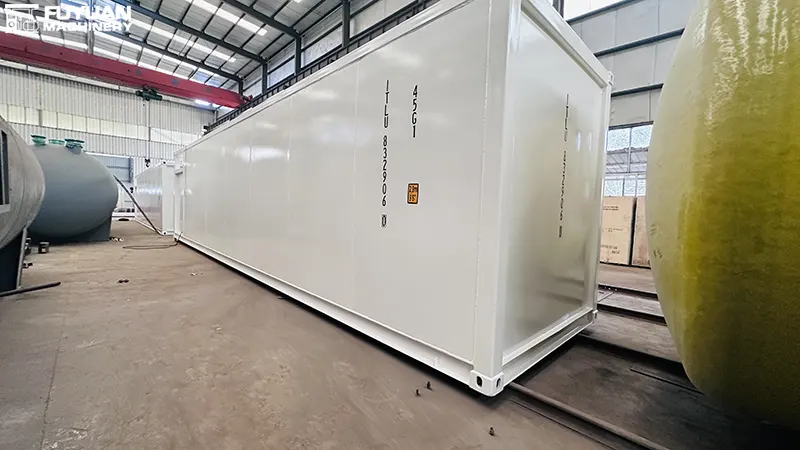
Factor 3: Certification and Compliance Package
Certification is not a "nice to have"—it is the difference between a station that gets approved and one that sits in a customs warehouse for 23 days.
ATEX and IECEx are the two dominant certification schemes for explosion-proof equipment. ATEX is mandatory EU law; IECEx is a voluntary international scheme accepted in 50+ countries globally. Both typically cost $15,000 to $50,000 per product line, with a timeline of 12 to 18 months. UL certification for North America runs $20,000 to $60,000 with a timeline of 12–24 months.
These costs are not optional line items—they are embedded in the equipment price. A dispenser with full ATEX Category 2G certification for Zone 1 operation costs significantly more than an uncertified unit. The most expensive mistake in explosion-proof fuel dispenser procurement is not buying the wrong brand—it is specifying a dispenser that passes factory inspection but fails field certification because one internal component lacks the correct explosion-proof rating. When a contractor in Lagos installed four new dispensers with ATEX-certified housings, the state petroleum inspector found a payment terminal with no Zone 1 certification. Every dispenser had to be decommissioned. Replacement components cost $15,000, and the station lost six weeks of revenue.
Regulatory compliance extends beyond equipment certification. In many jurisdictions, mobile fuel stations require safety assessments, fire inspections, and environmental approvals. These approval fees typically cost an additional 50,000 to 150,000 yuan.
The compliance cost equation: A station that appears $15,000 cheaper may lack the certification documentation that allows it to operate legally. The true cost is not the purchase price—it is the purchase price plus fines, delays, and replacement components.
Factor 4: Capacity, Flow Rate, and Dispensing Configuration
Capacity and flow rate are the two specifications that most directly affect both purchase price and operational cost.
Tank capacity ranges from compact 1,000L skids to 60,000L+ mining units. Price scales roughly linearly with capacity for the tank itself, but non-linearly for the overall system because larger tanks require stronger frames, larger secondary containment, and more robust dispensing systems. A standard 20ft container station holds approximately 30,000 liters; a 40ft unit holds up to 60,000 liters.
Flow rate is a less obvious but equally important cost factor. Heavy equipment in mining and construction needs high-flow diesel dispensers delivering 60–120 L/min, versus standard retail dispensers at 40–60 L/min. High-flow pumps, larger piping, and reinforced dispensers add cost—but they reduce refueling time by over 60%, which translates directly into reduced equipment downtime.
Dispensing configuration—single nozzle versus dual nozzle versus multi-product—adds incremental cost. A dual-product dispenser capable of handling both diesel and gasoline requires separate meters, hoses, and control systems. Multi-compartment tanks for storing different fuel types further increase complexity and cost.
The operational cost of undersizing is equally significant. A 1% calibration drift on a standard 5,000 L/day mining bowser costs approximately ₹1.35 lakh per month (about $1,600) in untracked diesel. Over a standard 300-day operational year, that is ₹16.2 lakhs (about $19,400) bleeding out of the operational budget. This is why high-accuracy metering (±0.2%) pays for the entire skid in less than one financial quarter.
Factor 5: Smart Technology and Fuel Management Integration
In 2026, the line between a "basic" and a "premium" mobile fuel station is increasingly defined by digital capabilities.
Modern stations integrate fuel management systems with RFID or PIN-based access control, real-time inventory monitoring, automated transaction logging, and remote telemetry. The penetration rate of smart skid-mounted units equipped with IC cards, license plate recognition, and remote tank level monitoring has already exceeded 60%, rapidly becoming the industry standard.
What smart technology adds to cost:
| Feature | Cost Impact | Operational Benefit |
|---|---|---|
| RFID/PIN access control | +$2,000 – $5,000 | Eliminates unauthorized fueling |
| Remote tank level monitoring | +$3,000 – $8,000 | Prevents fuel-out events |
| Automated transaction logging | +$1,500 – $4,000 | Full auditability, cost allocation |
| Predictive maintenance sensors | +$5,000 – $12,000 | Reduces unplanned downtime |
| Fleet telematics integration | +$4,000 – $10,000 | Route optimization, consumption tracking |
Many suppliers advertise "intelligent monitoring systems," but some units have the equipment without the corresponding functions. Oil leak detection systems and intelligent unloading systems are frequently listed as features but lack the sensitivity to actually perform their intended function.
The ROI of smart features: A mobile fuel dispenser with preset controller and printer converts a simple pump into a secure auditing station. The preset function prevents over-dispensing and ensures accurate reconciliation. For a fleet of 50 vehicles, eliminating unauthorized fueling and reducing administrative overhead typically delivers ROI within 12 to 18 months.
Factor 6: Shipping, Logistics, and Total Cost of Ownership
The purchase price is only the beginning. The true cost of a mobile fuel station is the total cost of ownership across its operational life.
Shipping and logistics: Containerized stations ship as standard ISO containers at ordinary container rates. Skid-mounted units often require flat-rack, break-bulk, or RO-RO shipping, which can incur out-of-gauge surcharges. For international projects, this difference alone can add $3,000 to $15,000 to the delivered cost.
Installation: Both formats can be operational within 1–3 working days with no civil works required. A traditional fixed fuel station, by contrast, requires 4–8 weeks for design and planning, plus 6–12 months for construction. The civil works component alone—excavation, in-ground tank installation, concrete bund, drainage, canopy—typically costs $80,000 to $250,000 on top of equipment costs.
Maintenance and operating costs: Skid-mounted units require only 2–4 employees to operate, with average annual labor costs around $80,000–200,000. Their open-frame design simplifies inspection and repair. Container units have slightly higher maintenance costs due to confined access but benefit from better protection against environmental degradation.
Residual value and relocation: A permanent fuel station has low residual value—decommissioning, tank removal, and site remediation are net costs. A mobile fuel station is fully relocatable by crane or forklift and retains high residual value. Market statistics show 68% of global temporary fuel supply projects choose relocatable skid-mounted systems, with equipment service life reaching 15–20 years.
TCO comparison over 3–5 years:
| Cost Category | Mobile Fuel Station | Permanent Fuel Station |
|---|---|---|
| Equipment purchase | $35,000 – $80,000 | $120,000 – $350,000+ |
| Civil works | None (concrete pad optional) | $80,000 – $250,000 |
| Installation time | 1–3 days | 4–16 weeks |
| Permits/approvals | Minimal | Full planning, environmental assessment |
| Relocation | Fully relocatable | Not relocatable |
| Residual value | High | Low |
| Total 3–5 year cost | 1x baseline | 3–5x higher |
A 2023 industry report found that businesses using mobile fueling solutions achieved ROI of 18.46% with positive Net Present Value and an Internal Rate of Return of 23.42% in the sixth year. For a 10-vehicle fleet, switching to on-site mobile fueling saves an average of $20,000 per year in avoided detours, labor, and retail fuel premiums.
Summary: The 6 Cost Factors at a Glance
| Factor | Key Decision | Cost Range Impact |
|---|---|---|
| 1. Station Type | Skid vs. container vs. trailer | 10–30% price difference between formats |
| 2. Core Equipment | Tank material, explosion-proof materials, dispenser brand | Up to 200% price variation for same capacity |
| 3. Certification | ATEX/IECEx/UL compliance package | $15,000–$60,000 per product line |
| 4. Capacity & Flow | Tank size, flow rate, dispensing configuration | Linear for tank, non-linear for system |
| 5. Smart Technology | Fuel management, telematics, access control | +$15,000–$40,000 for full integration |
| 6. TCO | Shipping, installation, maintenance, residual value | Mobile: 1x baseline; Permanent: 3–5x |
The Bottom Line
Buying a mobile fuel station on price alone is the most expensive decision you can make. The cheapest quote often hides uncertified explosion-proof components, undersized tanks, or missing compliance documentation—problems that surface as failed inspections, production stoppages, and emergency replacement costs.
The right approach is to evaluate total cost of ownership, not purchase price. A station that costs $15,000 more upfront but carries full ATEX certification, uses certified explosion-proof materials, and integrates smart fuel management will deliver lower lifetime cost and higher operational reliability.
The movable fuel stations market was valued at USD 925.17 million in 2025 and is projected to reach USD 1,850.36 million by 2032, growing at a CAGR of 10.40%. As adoption accelerates, the gap between well-specified and poorly-specified equipment will only become more consequential.
Get the six cost factors right—and your mobile fuel station will deliver exactly what it promises: reliable fuel where you need it, when you need it, at a cost you can control.
Looking for a mobile fuel station with transparent pricing and full certification?
Fuyuan Machinery manufactures containerized and skid-mounted fuel stations certified to UL, ATEX, IECEx, CE, ASME, and NFPA standards.
Contact us today for a customized solution with clear, itemized cost breakdown.
Written by
TAI'AN FUYUAN MACHINERY EQUIPMENT CO., LTD.
Editor Yuan
www.mobile-fuel-stations.com
WhatsApp:+86 182 6667 0999
Email:yuanyuzhu6@gmail.com

Leading Chinese Manufacturer & Exporter of mobile fuel stations and skid-mounted fuel stations.